
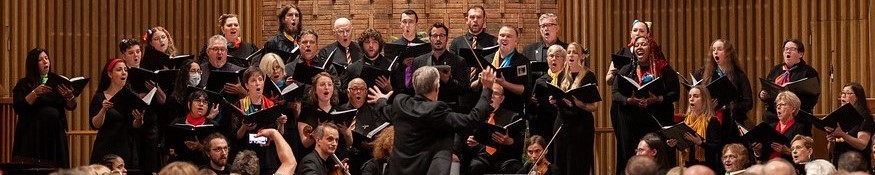
Master Singers of Worcester
Edward Tyler, Artistic Director
Mark Bartlett, piano
Michael McCarthy, piano & organ
50 Years – A Look Back
Saturday, May 16, 2026
4:00 pm
Trinity Lutheran Church
Reception to follow
Notes, Texts, and Translations
50 Years – A Look Back
The program for this afternoon’s concert comes from two sources. The first, programs of years past – the archive of performed works was quite revealing. For many years after its inception, Master Singers performed large works with orchestra and shared the stage with other local choral societies. Gradually, this gave way to a blending of larger works with concerts of shorter, more intimate choral pieces, and even a few Gilbert & Sullivan operettas. Many of the works in this concert saw their last MSW performance 25 to 35 years ago, and we’re glad to bring them back for you this evening.
The second source is our own active ensemble, who were asked to recommend their favorite MSW pieces from their time with the organization. I’ve done “singers’ choice” concerts in the past, and I’m always surprised at the depth and breadth of the suggestions – you just never know what will resonate with someone and create a lasting impression.
Happy Anniversary, Master Singers! And here’s to 50 more!
Edward Tyler, Artistic Director
The Last Words of David
Randall Thompson’s setting of II Samuel 23:1-7 has been a mainstay of choral literature since the 1950s, and has been featured on several past programs by the Master Singers of Worcester.
He that ruleth over men must be just, ruling in the fear of God.
And he shall be as the light of the morning, when the sun riseth, even a morning without clouds, as the tender grass springing out of the earth by clear shining, after rain.
Alleluia. Amen.
Libera Me
Written between 1887 and 1890, Fauré’s Requiem Mass marked a significant departure from the Romantic settings, like Verdi & Berlioz, where large performing forces and operatic performance practices were the norm. Fauré removed the Dies Irae sequence text entirely, creating a gentler and more conciliatory atmosphere. The only counterpoint to this approach is this movement, Libera Me, and its brief depiction of Judgement Day.
Libera me, Domine, de morte aeterna,
In die illa tremenda
Quando coeli movendi sunt et terra
Dum veneris judicare saeculum per ignem
Tremens factus sum ego et timeo
Dum discussio venerit,
Atque ventura ira
Dies illa, dies irae
Calamitatis et miseriae
Dies illa, dies magna
Et amara valde
Requiem aeternam dona eis Domine
Et lux perpetua luceat.
Deliver me, Lord, from death eternal
On that dreadful day.
When heaven and earth shall be moved
When you come to judge the world by fire
I am seized by trembling, and I fear
the coming judgement
I dread the coming wrath.
That day of wrath,
of calamity and misery
Momentous day
Bitter day.
Rest eternal, grant them, O Lord
is And perpetual light shine upon them.
Os Justi
This text is used for Masses dedicated to saints who were clergy, but had not achieved the rank of bishop or pope. Of the dozens of settings of this text, Bruckner’s is likely the most well-known.
Os justi meditabitur sapientiam
Et lingua ejus loquetur judicium
Lex Dei in ejus in corde ipsius
Et non supplantabuntur gressus ejus.
The mouth of the righteous utters wisdom
And his tongue speaks what is just.
The law of God is in his heart
And his feet do not falter.
Sonate, piano four hands
Franics Poulenc completed the Sonate when he was just nineteen years old, revising the work some twenty-one years later. Historians believe that the work shows a strong influence by Erik Satie, and not the other French masters of the time: Debussy, Ravel, and Fauré.
Abdenlied
Opus 92, Vier Quartette, was composed in 1884 and found its audience, not in the concert hall, but rather at parties and social gatherings, where patrons would gather and perform the work for entertainment.
Friedlich bekämpfen Nacht sich und Tag In peaceful opposition, night versus day
Wie das zu dämpfen, What ability it has to soften
Wie das zu lösen vermag. What ability it has to relieve.
Der mich bedrückte, Sorrow that oppresses me,
schläfst du schon Schmerz? are you already asleep?
Was mich beglückte, sage, was wars doch, What was it that made me happy?
Mein Herz? Speak, my heart.
Freude wie Kummer, fühl ich zerann,
Aber den Schlummer, führten sie leise heran
Im Entschweben, immer empor
Kommt mir das Leben ganz,
wie ein Schlummerlied vor.
In peaceful opposition, night versus day
What ability it has to soften
What ability it has to relieve.
Sorrow that oppresses me,
are you already asleep?
What was it that made me happy?
Speak, my heart.
Joy, like grief, melts away
But slumber comes, as it fades away.
And as it vanishes, ever upward
My entire life passes before me,
Like a lullaby.
The Ground
This work originates as the Sanctus movement of Gjeilo’s “Sunrise Mass,” which he later reimagined as a stand-alone work. MSW has performed both the full work and this variation in the past ten years.
Pleni sunt caeli, et terra gloria tua
Osanna in excelsis Hosanna in the highest.
Benedictus qui venit in nomine Domine
Agnus Dei, qui tollis peccata mundi
Dona nobis pacem,
Heaven and earth are full of your glory.
Hosanna in the highest.
Blessed is he who comes in the name of the Lord.
Lamb of God, who takes away the sins of the world
Grant us peace.
Three Little Maids from School
In the late 19th Century, Victorian England was obsessed with everything Japanese, from societal customs to fashion. Gilbert & Sullivan used this obsession to create one of their most popular works, “The Mikado,” a biting satire of British society, cloaked in the exoticism of the far away island nation of Japan.
Three little maids from school are we,
Pert as a schoolgirl well can be,
Filled to the brim with girlish glee,
Three little maids from school!
Everything is a source of fun.
Nobody’s safe, for we care for none!
Life is a joke that’s just begun!
Three little maids from school!
Three little maids who, all unwary,
Come from the ladies’ seminary,
Freed from its genius tutelary,
Three little maids from school!
One little maid is a bride, Yum-Yum
Two little maids in attendance come,
Three little maids is the total sum,
Three little maids from school!
From three little maids take one away,
Two little maids remain, and they
Won’t have to wait very long, they say.
Three little maids from school!
Ubi Caritas
The text and chant of the Ubi Caritas finds its liturgical home in the mandatum of Holy Thursday, where Jesus washes the feet of his Disciples.
Ubi caritas et amor, Deus ibi est.
Congregavit nos in unum Christi amor,
Exsultemus et in ipso jucundemur
Timeamus et amemus Deum vivum
Et ex corde diligamus nos sincero,
Gaudium quod est immensum,
Congregavit nos in unum Christi amor
Glorianter vultum tuum
Cum beatis videamus with blessings,
Where there is charity and love, God is there.
Christi amor, The love of Christ has gathered us together
Let us rejoice and be glad in it.
We fear and love the living God.
And let us love one another from a sincere heart.
Let there be immeasurable joy
Gathered as one in Christ’s love.
The glory of your face
with blessings, we may see.
The Runner
This new work by Joshua Rist was the most requested piece for this retrospective concert. It depicts the transcendental nature of running, as earth and air and physical rhythms make the runner feel as if their body will “burst into song.”
The ground fits his foot perfectly as he runs,
Each breath fits his lungs.
The earth pushes back with its slow spin.
While he crosses the golden field of barley,
It seems to him his body will burst into song.
1000 Beautiful Things
1000 Beautiful Things is a “promotional single,” meaning it was never formally released as a single for distribution, from “Bare,” the third album from Scottish singer Annie Lennox.
Every day, I write the list of reasons why I still believe they do exist.
A thousand beautiful things…
And even though it’s hard to see the glass is full and not half empty:
A thousand beautiful things…
So light me up like the sun, to cool down with your rain.
I never want to close my eyes again.
I thank you for the air to breathe, the heart to beat, the eyes to see again:
A thousand beautiful things…
And all the things that’s been and done, the battle’s won, the good and bad in everyone:
A thousand beautiful things…
So here I go again, singing by your window,
Picking up the pieces of what’s left to find.
The world was meant for you and me to figure out our destiny:
A thousand beautiful things…
To live, to die, to breathe, to sleep, to try to make your life complete:
A thousand beautiful things…
Light me up like the sun, to cool down with your rain.
I never want to close my eyes again.
The Innocence
“Considering Matthew Shepard” is a tour de force work by Craig Hella Johnson, the Artistic Director of Conspirare. It tells the story of the beating death of Matthew Shepard in the wilds of Wyoming, and of the impact upon our society writ large.
When I think of all the times the world was ours for dreaming,
When I think of all the times the earth seemed like our home,
Every heart alive with its own longing, every future we could ever hope to hold?
All the time our laughter rang in summer,
All the time the rivers sang our tune,
Was there already sadness in the sunlight? Some story waiting to be told?
Where, O where has the innocence gone?
Where, O where has it gone?
Rains, rolling down, wash away my memory.
Where, O where has it gone?
When I think of all the joys, the wonders we remember,
All the treasures we believed we’d never ever lose?
Too many days gone by without their meaning,
Too many darkened hours without their peace.
Where, O where has the innocence gone?
Where, O where has it gone?
Vows we once swore; now it’s just this letting go.
Where, O where has it gone?
The Promise of Living
Originally written for television, Copland’s “The Tender Land” was rejected by NBC for broadcast. Instead, the work received its premiere by the New York City Opera in 1954. The work was later rewritten for various performances, including Tanglewood and Oberlin College.
The promise of living, with hope and thanksgiving,
Is born of our loving, our friends, and our labor.
The promise of growing, with faith and with knowing,
Is born of our sharing, our love with our neighbor.
The promise of living, The promise of growing,
Is born of our singing, in joy and thanksgiving.
For many a year we’ve known these fields,
And known all the work that makes them yield.
Are you ready to lend a hand? We’re ready to work, we’re ready to lend a hand.
By working together, we’ll bring the harvest, the blessing of harvest.
We plant each row with seeds of grain,
And Providence sends us the sun and the rain.
By lending a hand, by lending an arm,
Bring out from the farm, bring out the blessings of harvest.
Give thanks there was sunshine, give thanks there was rain,
Give thanks we have hands to deliver the grain.
O let us be joyful, O let us be grateful to the Lord for his blessings.
O let us sing our song, And let our song be heard.
Let’s sing our song with our hearts, and find a promise in that song.
The promise of living, The promise of growing,
The promise of ending is labor, and sharing, and loving.